
By Dallas Looney
Throughout World War II, the Army field tested the M1 Carbine as a lightweight, and accurate weapon for officers and other soldiers who were not regularly issued the M1 Rifle, commonly referred to as the M1 Garand, after its designer, John Garand. Designed as a self-loading semiautomatic weapon, the M1 Carbine had left a substantial record in its service during the war. Soldiers largely praised its effectiveness in combat, as well as its light weight, giving relief to a soldier’s already heavy load. Yet there was an immense desire to counter the automatic weapons of the Wehrmacht. While the U.S. Army had automatic weapons to counteract the Germans, these were often heavy and unwieldy, such as the Browning Automatic Rifle, that failed to answer soldier’s requests for portable automatic firepower.
The development of the M2 Carbine began as far back as October 1940, when the Army was seeking a self-loading type of rifle that was capable of either semiautomatic or full automatic fire. While the M1 Garand would prove to be a mainstay within the Army’s arsenal, there was a desire for a weapon to use a smaller carbine round that could offer the stopping power of a rifle, while being easy to be mass produced. Throughout 1940, the Chief of Ordnance was issued an order to develop and test light rifles for service use. Preliminary testing of prototypes of the M1 Carbine followed suit the following year at Aberdeen Proving Ground in Maryland. As the selection process slimmed down through trials, the Ordnance Department withdrew its requirement for the automatic fire selection on the light rifle, leading to what became the M1 Carbine.
The competition was fierce as a few notable companies vied for the final prototype, but the contract would ultimately be secured by Winchester. The M1 Carbine would go on to have a famed reputation throughout World War II, where it was issued to personnel throughout the military from support staff to tank crews not usually issued rifles, but also to paratroopers and infantrymen to only name a few. Its service was vast and diverse amongst all branches of service, remaining a favorite for soldiers who preferred its lightweight as opposed to other, far heavier weapons.
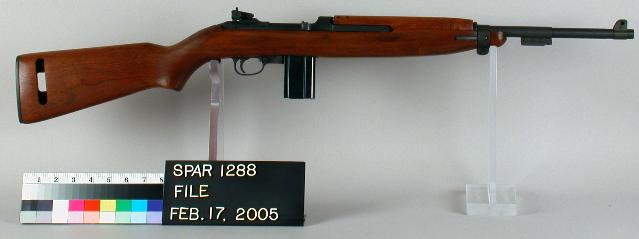
With World War II serving as a field test, soldiers throughout the theaters of war modified their own M1 Carbines to convert them into automatic weapons, revealing a pressing need these soldiers had for a weapon capable of automatic fire. Furthermore, the Ordnance Department provided T17 and T18 field conversion kits that converted the semi-automatic M1 into a select-fire weapon by adding a disconnector lever and selector switch, as well as modifying the existing sear, slide, and trigger housing. These kits saw use in the Army’s advance into Germany during the final year of the war and were widely sought after by soldiers for their reliability in providing extra firepower. The T17 and T18 conversion kits also saw extensive use during the liberation of the Philippines when U.S. forces under General Douglas MacArthur returned to liberate the archipelago. Soldiers throughout the war had continuously desired these modification kits to become a more permanent aspect to the M1 Carbines they were issued, sending their feedback throughout official channels and leading the Ordnance Department to once more approach the select-fire conversion issue.
Seemingly, their prayers would be answered when the Ordnance Department, Springfield Armory and Winchester worked on a selective-fire conversion of the M1 Carbine, designated “Carbine Caliber .30 M2,” in late 1944. This development came from both soldier feedback and the growing use of automatic weapons, such as the Sturmgewehr 44, the forerunner of the modern assault rifle. In response, the Ordnance Department introduced the fully automatic M2 Carbine, a select-fire modification of the M1 chambered in .30 caliber, capable of firing 750-775 rounds per minute. The M2 typically carried a thirty-round magazine (fifteen-round magazines were available as well but made for poor automatic results). When loaded, the carbine only weighed 5.8 pounds, a significant reduction in weight for when compared to the heavier M1 Garand that weighed 11.5 pounds loaded with its eight-round clip. Gas-operated with a rotating bolt, the M2 Carbine had an effective range of up to 330 yards (300 meters), making the most of its 17.75-inch barrel.
Seemingly, this development of a new version of the M1 Carbine would aid in providing that extra bit of firepower for troops that found the carbine to be a reliable asset in the field. This, however, would prove far too late in the timeline of World War II, and the M2 would enter production until April 1945. Few M2 Carbines saw service in World War II though with the T17 and T18 conversion kits, soldiers had the M2’s desired utility. Furthermore, certain modifications to the M2 Carbine were made for the field such as the M2A1, which shared the qualities of the M2 but brought over the folding stock of the M1A1 Carbine. Many soldiers preferred the M2 (and the conversion kits for the M1) as a weapon simply for the matter in which it fired a .30 round which had far more range penetration than the pistol rounds other automatic weapons and sidearms utilized. One of the more unique modifications of the M2 Carbine that would expand beyond the scope of World War II was the induction of the M3 Carbine, a modified M2 Carbine fitted with a mount for an infrared scope. Fewer than three thousand of this variant of the M2 Carbine were issued, and they saw action in the battle for Okinawa and later in the Korean War, though they remained a rarity due to its unique nature and egregiously heavy extra twenty-five pounds added onto the six-pound weapon after the entire infrared kit was equipped.
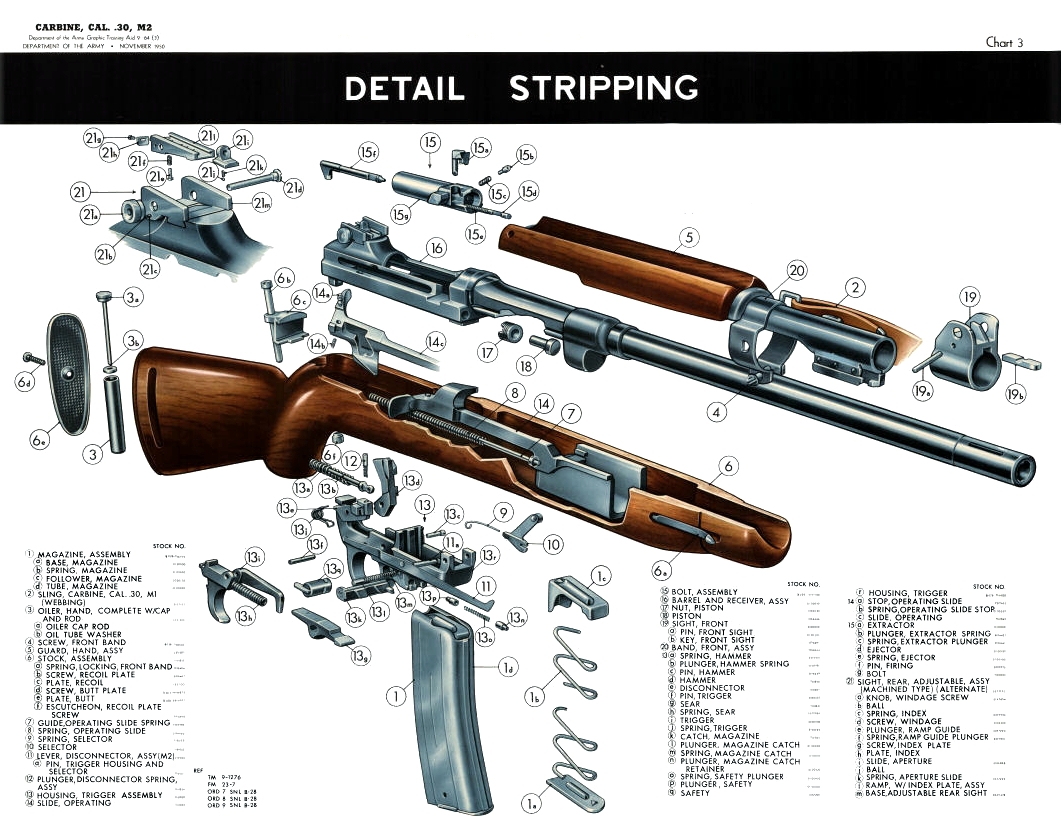
With the conclusion of World War II, the Ordnance Department conducted a large-scale rebuilding program for the M1 Carbines that had been issued in the war, converting them to the M2 variant. This would be no easy task, as nearly six million of these carbines were produced in World War II alone. It was a costly and time-consuming program, but ultimately ensured that the M2 Carbine would see service in future conflicts.
Little could prepare the Army for the Korean People’s Army (KPA) surprise assault across the 38th Parallel and into South Korea. Forced into a pocket of land along the southern coastal city of Busan, the Army rushed troops from Japan largely armed with surplus weapons and equipment from World War II. The M2 Carbine (as well as the earlier M1s and the M1 Garand) would find itself pushed to the forefront and serving directly on the frontline, becoming a mainstay small arm for soldiers.
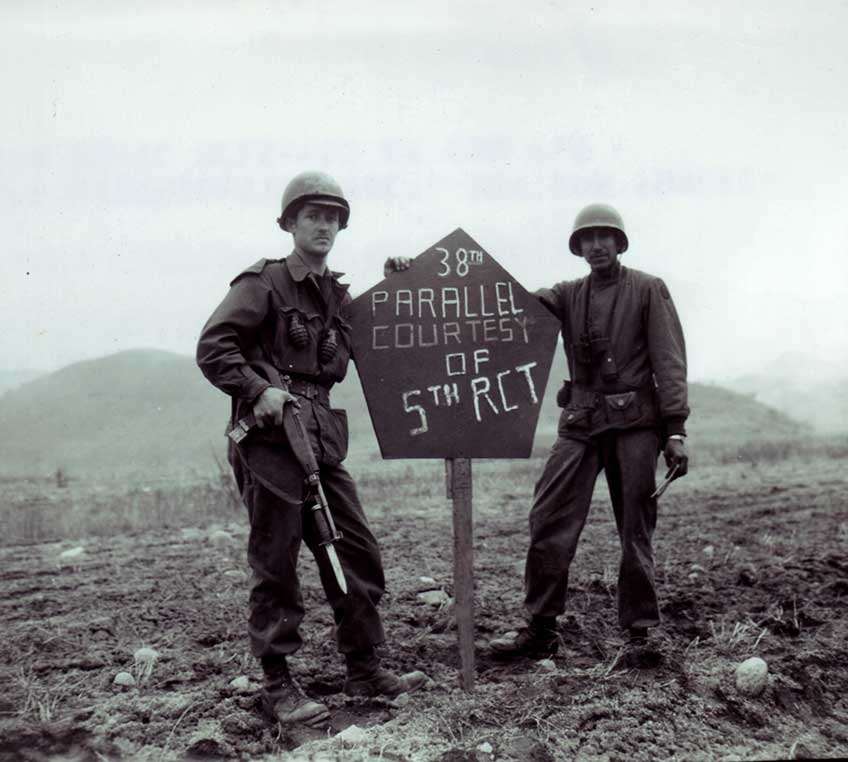
Performance of the M2 Carbine during the Korean War varied, as previous complaints regarding the carbine from its performance in World War II once more arose. Soldiers often complained about the range of the carbines as well as bullet stopping power. which seemed to be lackluster against the heavily layered KPA and Communist Chinese troops. In truth, the penetration complaint was largely a myth rather than a fault of the M2. Furthermore, the ease of access to select-fire and the overwhelming numbers of the enemy led many soldiers to rely upon automatic fire as a solution, which quickly depleted ammunition.
While the M2 proved to be an asset in the early days of the war, as United Nations forces began to advance northward, so too did their troubles with the new carbine. Jamming became a widespread issue in the the hilly, mountainous terrain that drew mud and snow upon soldiers weapons during times of combat, a problem that only increased as frigid air froze parts of the weapon, which had never been designed to be employed in the subarctic temperatures common in Korea. This was not entirely the fault of the M2’s design, however, as the Army struggled across the board with equipment that simply was not meant to be used in such frigid and environmentally hostile conditions.
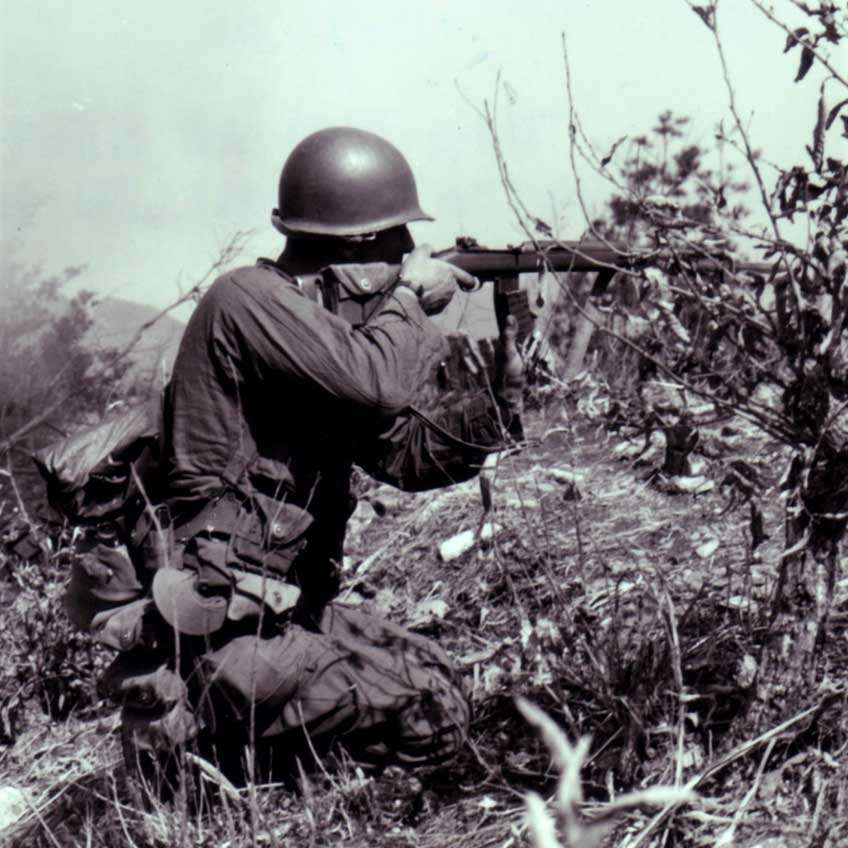
With the carbine’s reputation already on shaky ground in World War II, the Korean War seemed to all but certainly sign the death warrant on its use in future conflicts. Complaints rolled in that the M2 Carbine simply was not built for the conflicts ahead. Still, while the Korean War wound down and soldiers returned from their long deployment overseas, the M2 once more found a home within the military’s warehouse surplus.
A mere few years later from the Korean War, a conflict was quickly brewing in Southeast Asia, as the country of South Vietnam faced internal conflict that intensified from a local insurgency to large-scale conflict involving hundreds of thousands of troops. In 1956, U.S. military advisors across South Vietnam were issued M1/M2 Carbines as part of their kit. Advisors praised the M2’s performance and made extensive modifications to their carbines while in the field, the most popular of which focused on shorter-range implementations. Unique modifications opted to create an even lighter carbine by shortening the barrel. In the mid-1960s, the Kennedy administration, seeking to bolster the Army of the Republic of Vietnam (ARVN) and the existing American military advisors in South Vietnam, began to export old military surplus, including M1/M2 Carbines.
The surplus American weapons, including M1 and M2 Carbines, were offered up to the ARVN to help offset equipment differences against their enemy, the Viet Cong (VC) and North Vietnamese Army (NVA). Many ARVN soldiers preferred the carbines’ light weight and stability against some of the other weapons offered by the Americans. M1 and M2 Carbines became the standard issue rifle for the ARVN early in the war and proved effective against their Communist foes. It tended to perform quite well by all accounts within short-range, open-engagements, with soldiers complimenting the stopping power of the .30 caliber round and the accessibility of fully automatic fire with the M2.
Despite this, issues did persist with the M2. Notably, the weapon still faced many of the same problems with jamming and inaccurate automatic fire. The shorter range, ambush-styled engagements in Vietnam, bolstered by the dense foliage and fortifications employed by the VC and NVA only exacerbated the problem, leading to the .30 caliber round failing to penetrate the thick jungle foliage and VC/NVA bunkers. The humid climate and an maneuvers through jungles, mud, streams, and ride paddies also led to maintenance issues.
As the war continued throughout the 1960s and the early 1970s, the U.S. Army pushed its attention towards further advancement of the M16 line of rifles. Eventually, ARVN troops were largely equipped with the M16, and the M1/M2 Carbines were largely phased out of service with South Vietnamese forces.
Police forces utilizing the carbine and the occasional arms-dealing with allies led the M2 Carbine to pop-up around the world in the aftermath of the Vietnam War, where it continued to be a presence particularly in Asia, the Middle East, and North Africa, but by the end of the war the M2 Carbine had largely faded from the Army’s attention. Developments toward a more effective carbine in what would eventually become the M4 Carbine took particular attention as the Army looked to modernize its arsenal. As a result, the M2 remained in stockpile, or was traded off to allies across the world. Current use of the M2 Carbine is scarce with the passing of time, but police forces in Brazil, South Korea, and Taiwan are known to use the M2 to this day. Through trials and tribulations, the M2 Carbine was both a boon and a bane to those who carried it in combat, and it served as a necessary step toward truly effective automatic assault rifles.
About the Author:
Dallas Looney is a Digital Historian for the Army Historical Foundation’s History Department. He holds a B.A. in History from New Mexico State University and an M.A. in History, with a concentration in Comparative World History, from George Mason University.


